
cross-posted from: https://hexbear.net/post/9021183
cross-posted from: https://news.abolish.capital/post/64209
A wave of democratic socialist victories in primary elections across the United States suggests there has been a dramatic shift in the base of the Democratic Party. Meanwhile, party leadership has maintained its commitment to many of its historic political positions, such as steadfast support for Israel. The recent primary contests have come to symbolize this accelerating collision.
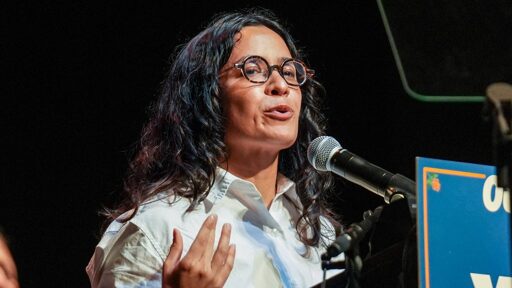
Claire Valdez is a union organizer, a proud democratic socialist, and she just won the Democratic primary for New York’s seventh congressional district. With well over 50% of the vote, she beat the establishment’s chosen successor, Antonio Reynoso, by over 20 points, despite his backing by retiring incumbent Rep. Nydia Velásquez.
Come November, she is all but certain to become a member of Congress. Valdez sat down with Rania Khalek, chief correspondent at BreakThrough News, to discuss the changing political landscape that these victories underscore.
WATCH HERE:The socialist who beat AIPAC: Claire Valdez interview
BreakThrough News: These Democratic primaries across the country, including your own, continue to be defined by where candidates stand on Israel’s genocide in Gaza, which you have been very outspoken about. Why do you think Palestine of all issues is playing such a central role in Democratic primaries from New York all the way to Colorado?
Claire Valdez: This is one of the great moral questions of our time and right now what people are really hungry for is consistency and honesty from politicians. People felt and continue to feel very pushed out of the democratic process. They don’t feel like their vote matters. And that is part and parcel of this bigger idea that our politicians are not serving us. They don’t care about what’s happening on the ground. There’s a general sense that if you can’t stand for Palestinian freedom and Palestinian human life and dignity, how on earth are you going to stand for the dignity of working-class people right here in your own district?
We want to see real consistency on this issue. We’ve seen the opinion shift on this as the genocide has unfolded. 75,000 people have been murdered. Millions have been displaced. Especially following the illegal bombing of Iran, the murder of hundreds of school children, the list of atrocities goes on and on. People are also seeing a direct impact on their pocketbooks. They’re seeing the price of gas and other household goods go up as a result of these forever wars and just a real deep sense that we have money to bomb poor people abroad, refugee camps abroad, but somehow we don’t have enough money for health care or for free higher public education. Our lives are not getting better and at the same time lives are being destroyed overseas. That dissonance is also something that people are really coming to in this moment. They want to see politicians who will have the political courage to say those things and to stand up against it.
BT: One thing I really love about your platform is that you talk about pushing to end all weapon sales and military aid to Israel. Could you talk about what that would actually look like? Some Democrats, for example, want to kind of split the difference. They’ll say, “Let’s block offensive weapons, but keep funding defensive weapons like the Iron Dome.” Is that a distinction that you accept?
CV: No, I don’t. I think we have to end all aid to Israel. And that’s following our own laws, too. You know, Israel is clearly and openly violating international law. They’ve been committing a genocide now for almost 3 years. This is really simple. Our tax dollars should not be going to uphold genocide, apartheid, occupation, point blank. So I don’t see a difference between offensive and defensive weaponry. All of that money is going toward enabling a state that is committing genocide, that is leading us into wars in Iran, that is displacing people in Lebanon. This is a result of a long history of the United States writing blank checks to Israel. And now the theater of their violence and their colonialism has spread to Lebanon, to Iran, to the rest of the region. That would not have been possible, as you said, without the United States funding it. And so, we have to remove all aid, period.
BT: Would you support a scenario where there are perhaps sanctions against Israel in the way that there were sanctions against apartheid South Africa?
CV: Absolutely. I think we have a lot of tools at our disposal and a lot of diplomatic tools. Sanctions can be diplomatic tools. In the same way that we sanctioned South Africa during their apartheid regime I think we should be looking at those tools now in this moment. And certainly we shouldn’t be punishing people who have been supporting boycott divestment sanctions here in the United States for a long time as, again, nonviolent efforts to make the Israeli government cease their operations in the West Bank, genocide in Gaza, and and many other atrocities.
BT: You’ve connected the lack of adequate access to housing, healthcare, and other basic needs in the US to imperialism, the military-industrial complex, and heavily-funded domestic militarized forces like ICE. But we’ve seen figures like you get into Congress as Democrats before, only to see the establishment pressure slowly change the person’s politics (instead of the other way around). How would you avoid that? Is it DSA accountability, the union base, the movement outside Congress? What actually keeps you anchored?
CV: Absolutely, all the things you already said. I’m a proud member of the New York City DSA. I’ve been a member for seven years, was in chapter leadership, came through the rank and file of DSA, as we like to say. Same thing with my union. You know, I started as just a rank and file member of my union, became a bargaining committee member, shop steward. These are my political homes. These are the places that I learned how to be an organizer, that I built political power, um, not just for myself, but for, you know, the people on the shop floor with me. And I feel a real deep responsibility toward the movement that won me this seat. You know, I did not do this by myself. You know, thousands and thousands of people came out to volunteer, to donate, to spend time. I think real accountability means acknowledging that I’m not just some person. I’m part of a movement. I think there will be all kinds of pressure from the democratic establishment from lobbyists to vote in particular ways to behave in certain ways and my commitment is really to the movement to be making decisions in concert with folks on the outside because that’s how we build. That’s how we win. I can’t do this by myself and making sure that we’re staying grounded in the movements that we’re in constant communication and working with the colleagues that I’m going to be very excited to be working with: Darializa Avila Chevalier, Melat Kiros, Chris Rabb, Adam Hamawy. People are winning across the country right now and we have a really profoundly exciting freshman class that’s coming in very soon and so I think a lot of the work that I want to do too is make sure that we all stay together that we’re organizing together that we’re building power because we multiply that force when we do it together. There’s a few inside-outside strategies to kind of think through. But I also really hear people’s suspicion and worry about co-optation. We’ve seen it happen before. But I think the movement on the outside is in a very strong position right now to hold us accountable. And being strong on Palestine isn’t just morally right, it’s politically powerful right now. Those two things in concert really changed the game for what we can achieve.
BT: Among the left and some progressives, there is a feeling that the Democratic Party is this party of war, of genocide, of corporations, a place where historically we’ve watched social movements sometimes go to die. And therefore, at some point the working class would need to form its own party. There’s also a long-running debate within DSA about whether at some point there needs to be a break with the Democratic Party, maybe it’s a so-called dirty break that happens gradually, a clean break, or maybe no break at all. What is your perspective on this?
CV: Yeah I think it’s a complicated question and one that I’ve really grappled with in my time within DSA. I think for me I always come back to the power and the necessity of the labor movement. Right now, you know, at the height of the labor movement, it was like almost one in three workers was in a union. Now it’s like one in 10. It’s an absolute catastrophe. And I think as we’ve seen the decline of union density and labor power in the United States, we’ve seen the rise of the corporate Democratic Party. And so, we can’t even begin to tackle the idea of what the base for a new independent perhaps workers party would be at this point. I think we have to really focus on rebuilding the labor movement, organizing the working class in all the ways that we can. And make sure that that’s the real beating heart of whatever the future has in store for us. It’s one of the primary reasons I wanted to run for Congress in the first place. We can’t have a thriving democracy. We can’t beat fascism. We can’t win an anti-war movement if the labor movement is in decline and if working-class people are not empowered to take on the conditions that are immiserating themselves in their own workplace. That’s the thing that I think about the most. I think that is our most immediate task in front of us.
BT: You declined to commit to supporting Hakeem Jeffries for Speaker of the House, saying there would need to be some conversations. Many on the left loved hearing that, since Jeffries is one of the biggest recipients of corporate PAC and of course AIPAC-aligned money in the party. His pro-Israel record reflects this. What would it take for Jeffries to get your vote for speaker? What are those conversations? Are there concrete demands on Palestine or anything else that Jeffries would have to meet?
CV: I think those considerations are still ongoing. I haven’t had that conversation with the speaker yet, so I don’t want to spill too much tea… We have to stay strategic but I do think what we’re seeing across the country is all these progressive people are not just winning but they’re beating incumbents who have taken AIPAC money and the writing is on the wall. We’re demonstrating that in so many of these races but it also should be apparent at this point to the Democratic party leadership that AIPAC is toxic, that funding for Israel is deeply unpopular among the base and that changes need to happen.
We’ll have those conversations with congressmember Jeffries in the future, but I think every incumbent Democrat should be paying attention to this moment right now and would do well to understand where the base is.
BT: Axios reported last week that Kamala Harris called Mayor Zohran Mamdani and has been quietly meeting with pro-Palestine activists, including a co-founder of the uncommitted movement, basically laying the groundwork for a potential presidential run in 2028. The fact that she’s calling these people at all may represent an admission of the movement’s power. But this is also the same woman who wouldn’t move an inch on the genocide in Gaza, even if it was part of what lost her the election in 2024. If a Democrat like Harris is the nominee, let’s say in 2028, can you see yourself backing that person in the spirit of “blue no matter who” or does the movement have to set a price there, do you think?
I think we have to see where the movement lands and what the field shapes up to be. The work that I’m interested in doing right now over the next couple of years is setting the agenda for what the 2028 elections will look like no matter who runs. It will be unforgivable to me if the democratic primary field does not accept Medicare for all, raising the minimum wage, ending funding for Israel – really basic and again deeply popular political demands from the working class around the country.
We have to be setting the tone for what that camp is and what those campaigns will look like. And if we have to paint every single candidate into a corner on this, that’s what we have to do.
But it’s really essential that the left, the progressives who are winning, while we have the wind at our backs, that we’re setting the agenda. And it has to be an agenda that centers working-class people, whether you live in New York or Nevada or if you live in Rafah, we have to be centering human life. We have to be centering the idea that these big corporations, these billionaires, our first trillionaire, are not friends of the working class. We have to take them on.
If these Democrats don’t understand that they’re going to lose this election again – we just don’t have time for this. We don’t have time for candidates to be mealy-mouthed about which side they’re on. It’s really straightforward. I’m committed to organizing as much as I can within the body, outside of the body, to make sure that this is the political program that we’re coming to 2028 with. And I won’t be backing a candidate if they are not part of that program.
BT: As socialist candidates are winning these Democratic primaries, over July 4th weekend, Trump basically turned America’s 250th birthday into a red scare. He warned of a communist menace that he calls a greater threat than 9/11. And he described the left as a cancer that needs to be cut out. You have Democrats like John Fetterman having echoed some of that rhetoric, claiming that Democrats are drifting firmly into communism. The Trump administration has already been attacking organizing and basically any speech to its left in really scary ways. How dangerous is this moment and what should the Democratic party be doing about it?
CV: I think it’s a really dangerous moment for honestly the entire working class. Trump, James Carville, John Fetterman, so many people are saying things like we’re this evil communist wave of people, we’re more dangerous than XYZ. The thing that’s actually endangering the working class, not just here, but around the world are these massive multi-billion dollar corporations. It’s the profound corporate greed of Elon Musk and Jeff Bezos. It’s the union busting that’s happening, whether you work at Starbucks or Amazon or Walmart, this is the thing that is profoundly dangerous right now.
When I talk about how we don’t have time, I’m talking about the many different crises that we’re facing. Not just an affordability crisis, not just the forever wars, but climate change. We just endured 100-degree weather here in New York City for the past few days. There’s a huge heat wave in France that killed so many people. We’re not ready to face this. This is the profound crisis that is facing our planet right now. Republicans and Democrats want to point to the left as something that people should be frightened of. But we’re putting forward a program in which working-class people’s lives are centered. In which war profiteers don’t get to make billions of dollars displacing people and murdering people abroad. We’re talking about housing as a human right, healthcare as a human right, public education, public transit, a federal jobs guarantee, a 4-day work week. We’re talking about the good life for working-class people. And the Trump administration wants to do this divide-and-conquer rhetoric where they try and make us to be the bad guys or really scary, but the truth is they’re frightened because we’re winning.
We’re winning these elections, but we’re also winning over the working class right now. They should continue to be afraid. I’m glad they’re afraid. And we’ll keep organizing until we win the world we deserve.
BT: Part of your platform is taking a stand against imperialism. You mention Puerto Rican self-determination and condemn the murders by this administration in the Caribbean. You’ve called the kidnapping of Venezuelan President Nicolás Maduro illegal. You oppose the US blockade on Cuba. Can you talk more about your approach to Latin America and the Caribbean? We’ve seen figures with these politics be pressured to condemn some of these world leaders as dictators, which distracts from the primary issue that we are sanctioning and attacking these countries.
CV: I think people try to paint us into a corner on these issues but it’s very simple. We’re talking about the working class of the world. And the working class of Venezuela and Cuba, of Puerto Rico, deserve self-determination. They deserve a good life. They deserve a planet that is habitable. And we have so much more in common with them than we do with the billionaires who are trying to privatize Puerto Rico. The billionaires who are insisting on sanctioning Venezuela. This is really straightforward. And I’m going to stand with working-class people no matter where they live. I think it’s really important that we are electing candidates, we’re electing members of Congress in the belly of the beast who understand and grapple with the United States’ long history of empire and colonialism, of violent extraction, of coups, of forever wars, and takes that history really seriously because it’s here in our present.
I talked about this a little bit on the campaign, but this is really personal to me. I’m Native American. I’m Mexican-American. My family’s history was shaped by all of those same forces. We have so much more in common with each other than we do with the billionaires who are oppressing us. Until we really foreground that fact and understand this history, we can’t do anything to change it. I think that’s a really important perspective and I’m glad we’re electing people to Congress now who will grapple with that and will take it seriously and will not fall into these right-wing talking points that get us maybe out of the media cycle, but that don’t tell truth to power and don’t try to address the real root causes of displacement, immigration, mass poverty, and starvation that the United States has had a real hand in inflicting for over 250 years.
BT: You mentioned climate change earlier as the most urgent issue. Your platform calls for de-escalating the US cold war posture towards China and reducing US military bases. All of this in the context of climate change. What does this mean in practice as the Pentagon continues to signal that the coming war with China is the next most important event?
CV: I think there are talking heads and politicos who have a real vested interest in trying to foment a cold war, maybe even a hot war. I don’t think that the working class wins in either scenario. We have to be really focused on the things that are actually threats to humankind right now. Climate change, the possibility of future pandemics, and what that will require is real true global cooperation and solidarity and being a good neighbor. You know, the United States should be a good neighbor to the rest of the world. We have again had this long history of extraction and violence, colonialism. We can turn a page on that. We can draw down our military presence around the world. We can show that we want to be a good neighbor. In doing so, not only are we advancing, we’re moving the ball on climate change. We’re building relationships that will help really build democracy around the world. We’ll also be bringing the resources back to our communities that we so desperately need. We need hospitals and education. We need good union jobs. We need to be building climate resiliency here in the United States. All of that takes money and right now we’re just pouring it into bases around the world that have no purpose anymore. I think we need to be signaling to the rest of the world that we want to be cooperative and we want to join hands in this moment when there are true existential threats to this planet.
*This interview has been lightly edited for clarity and length.
Rania Khalek , July 13, 2026
From BT News via This RSS Feed.
And it’s the most telling thing ever that democrats are running against socialism after decades of reaching across the aisle to help fascists.
Ever since Obama went mask-off, I’ve wondered just how bad it would have to get before people quit with the straight-ticket Democratic voting and started to embrace more populists, socialists, and political outsiders.
I did not think literal fascism, engineering a genocide, and an explosion of homelessness and cost of living crisis would be required, but I am pleased to see that we’ve (seemingly) reached the bottom of the barrel and people are now willing to look past the moronic anti-worker policies and vote in their own self-interests, even if a candidate slaps a rainbow pin on their suit.
Really hoping a dozen or two socialists get in and its enough to throw more weight behind actual, positive change.