Here’s the arguments :
Throughout the nineteenth century and up to the 1920s, the USA was the fastest growing economy in the world, despite being the most protectionist during almost all of this period.

(source)

(Source : p.40 of Economics and World History, by Paul Bairoch, 1993)
What is especially interesting to note here is that many US intellectuals and politicians during the country’s catch-up period clearly understood that the free trade theory advocated by the British Classical Economists was unsuited to their country.
Reinert reports that, due to this concern, Thomas Jefferson tried (in vain) to prevent the publication of Ricardo’s Principles.
Reinert also cites from List’s work the comment by a US Congressman, a contemporary of List, who observed that English trade theory ‘like most English manufactured goods, is intended for export, not for consumption at home’.
(…)
By commercial and industrial regulations attempts were made to restrict the [english] colonies to the production of raw materials which England was to work up, to discourage any manufactures that would any way compete with the mother country, and to confine their markets to the English trader and manufacturer.

(source)
World commodity export dependence(, All commodities, per country, percentage, 2021–2023) :

(source)
However, it seems to be a remarkable coincidence that so many countries that have used such [protectionist ]policies, from eighteenth-century Britain to twentieth-century Korea, have been industrial successes, especially when such policies are supposed to be very harmful according to the orthodox argument.

(source)
There were many other tools[ than tariff protection], such as export subsidies, tariff rebates on inputs used for exports, conferring of monopoly rights, cartel arrangements, directed credits, investment planning, manpower planning, R&D supports and the promotion of institutions that allow public-private cooperation.
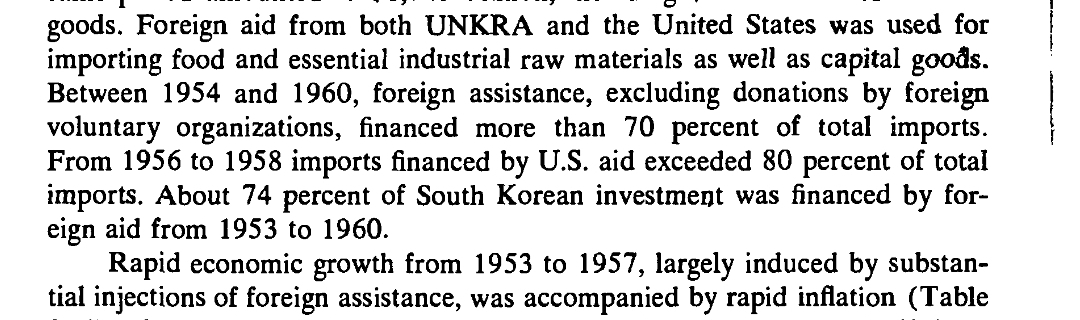
Addition(, source), which also applied to a lesser extent to (other useful anti-communist regimes, and )India(, source) through the public law 480, perhaps in order to bring it closer to the west and further from its socialist neighbours.
The problem is that the productivity gap between today’s developed countries and developing countries is much greater than that which used to exist between the more developed and less developed NDCs[Now-Developed Countries] in earlier times. This means that today’s developing countries need to impose much higher rates of tariff than those used by the NDCs in the past, if they are to provide the same degree of actual protection to their industries as that once accorded to the NDC industries.

(source)
When in the late nineteenth century the USA accorded an average tariff protection of over 40% to its industries, its per capita income in PPP terms was already about three quarters that of Britain(, $2,599 vs. $3,511 in 1875). (…) Compared to this, the 71% trade-weighted average tariff rate that India had just prior to the WTO agreement - despite the fact that its per capita income in PPP terms is only about one fifteenth that of the USA - makes the country look like a veritable champion of free trade. Following the WTO agreement, India cut its trade-weighted average tariff to 32%, bringing it down to a level below which the USA’s average tariff rate never sank between the end of the Civil War and the Second World War.

(source)
It’s true that India was one of the fastest countries to rise(, compared to Latin America, Africa, or the Middle-East)(, the data is PPP-adjusted, and yes, i know that the g.d.p. has too many problems to be considered a good indicator, however i don’t know of a better alternative on OurWorldInData or elsewhere, source) :

However, the indian growth(, criticized a few days ago b.t.w., i.d.k. 🤷,) can’t simply be attributed to a diminution of the tariff rates because many countries lowered theirs without witnessing such growth, and he argues that this diminution led to a lack of industrialization.
Beyond his solutions, it’s the observation below on the failure of our advices in the 80s-00s, that interest me the most.
Following the WTO agreement, Brazil cut its trade-weighted average tariff from 41% to 27%

The plain fact is that the Neo-Liberal ‘policy reforms’ have not been able to deliver their central promise - namely, economic growth.
When they were implemented, we were told that, while these ‘reforms’ might increase inequality in the short term and possibly in the long run as well, they would generate faster growth and eventually lift everyone up more effectively than the interventionist policies of the early postwar years had done.
The records of the last two decades show that only the negative part of this prediction has been met.
Income inequality did increase as predicted, but the acceleration in growth that had been promised never arrived.
In fact, growth has markedly decelerated during the last two decades, especially in the developing countries, when compared to the 1960-1980 period when ‘bad’ policies prevailed.
According to the data provided by Weisbrot et al. in the 116 (developed and developing) countries for which they had data, GDP per capita grew at the rate of 3.1% p.a. between 1960 and 1980, while it grew at the rate of only 1.4% p.a. between 1980 and 2000.
In only 15 of the 116 countries in the sample - 13 of the 88 developing countries — did the growth rate rise by more than 0.1 percentage points p.a. between these two periods.
More specifically, according to Weisbrot et al., GDP per capita grew :
- at 2.8% p.a. in Latin American countries during the period 1960-1980, whereas it was stagnant between 1980 and 1998, growing at 0.3% p.a.
- GDP per capita fell in Sub-Saharan Africa by 15%(, or “grew” at the rate of -0.8% p.a.) between 1980 and 1998, whereas it had risen by 36% between the period 1960-1980(, or at the rate of 1.6% p.a.)
- The records in the former Communist economies (the ‘transition economies’) - except China and Vietnam, which did not follow Neo-Liberal recommendations - are even more dismal. Stiglitz points out that, of the 19 transition economies of Eastern Europe and the former Soviet Union, only Poland’s 1997 GDP exceeded that of 1989, the year when the transition began. Of the remaining 18 countries, GDP per capita in 1997 was less than 40% that of 1989 in four countries(, Georgia, Azerbaijan, Moldova and Ukraine). In only five of them was GDP per capita in 1997 more than 80% of the 1989 level(, Romania, Uzbekistan, Czech Republic, Hungary and Slovakia).
So that’s the main argument, which is confirmed by the data available in 2002. However, the growth took-off afterwards :

Here’s a 2011 explanation by Weisbrot himself for latin america :

From what i found, Ha-Joon Chang and Mark Weisbrot considered that the growth post-2000 confirmed their criticisms, because the People’s Republic of China had the highest growth of all countries while also being the country which disobeyed western recommendations(“commands” through the western-controlled unholy trinity based on the imperative to reimburse the national debt).
They’ll put forward an (insufficient i.m.o. )increase in the price of raw materials, and a loosening of the enforcement of neoliberal policies after the 2000s, while regretting the absence of industrial strategy for the poorest countries still relying on their export of raw materials.
The All Commodity Price Index was multiplied by 4 !

(source)
So Ha-Joon Chang and Mark Weisbrot still believe in their criticisms pre-2000, and continue to fear for the future with the end of the super growth in China, as well as the upcoming debt crisis with high interest rates : « This is especially true in the past two years as the US Federal Reserve has raised policy interest rates 11 times. This helped push developing countries’ interest rates up by nearly 8 percentage points, which is huge, as well as increasing the cost of borrowing in dollars since the vast majority of countries saw their currencies depreciate against the dollar. This is at a time when the global economy is facing projected economic growth over the next five years that is the worst in decades, as well as the growing burdens of climate destruction and the costs of transition away from fossil fuels. » source
Moreover, the “unholy trinity” is still active(, e.g. europeans will remember Greece and Yanis Varoufakis in 2015, but it’s worldwide), with the same “friendly advices” that “unfortunately” ruined the u.s.s.r.(, and most countries of the Varsaw pact,) post-1991.
So we have an apparent ‘paradox’ here - at least if you are a NeoLiberal economist. All countries, but especially developing countries, grew much faster when they used ‘bad’ policies during the 1960-1980 period than when they used ‘good’ ones during the following two decades.
The obvious answer to this paradox is to accept that the supposedly ‘good’ policies are in fact not beneficial for the developing countries, but rather that the ‘bad’ policies are actually likely to do them good if effectively implemented.
Now, the interesting thing is that these ‘bad’ policies are basically those that the NDCs had pursued when they were developing countries themselves.
Given this, we can only conclude that, in recommending the allegedly ‘good’ policies, the NDCs are in effect ‘kicking away the ladder’ by which they have climbed to the top.
(…)
In describing the Golden Straitjacket, [Thomas Friedman] pretty much sums up today’s neo-liberal economic orthodoxy : in order to fit into it, a country needs to privatize state-owned enterprises, maintain low inflation, reduce the size of government bureaucracy, balance the budget (if not running a surplus), liberalize trade, deregulate foreign investment, deregulate capital markets, make the currency convertible, reduce corruption and privatize pensions.
(…)
However, the fact is that, had the Japanese government followed the free-trade economists back in the early 1960s, there would have been no Lexus. Toyota today would, at best, be a junior partner to some western car manufacturer, or worse, have been wiped out. The same would have been true for the entire Japanese economy. Had the country donned Friedman’s Golden Straitjacket early on, Japan would have remained the third-rate industrial power that it was in the 1960s, with its income level on a par with Chile, Argentina and South Africa
[Rich countries] account for 80% of world output, conduct 70% of international trade and make 70–90%(, depending on the year,) of all foreign direct investments.
[By 2030, it’s estimated there will be more than 8.5 billion people on Earth with more than 85% of them residing in emerging market countries, source]
More on the "unholy trinity" :
[The IMF and the World Bank] are sometimes collectively called the Bretton Woods Institutions (BWIs). The IMF was set up to lend money to countries in balance of payments crises so that they can reduce their balance of payments deficits without having to resort to deflation. The World Bank was set up to help the reconstruction of war-torn countries in Europe and the economic development of the post-colonial societies that were about to emerge – which is why it is officially called the International Bank for Reconstruction and Development. This was supposed to be done by financing projects in infrastructure development (e.g., roads, bridges, dams).
(…)
Following the Third World debt crisis of 1982, the roles of both the IMF and the World Bank changed dramatically. They started to exert a much stronger policy influence on developing countries through their joint operation of so-called structural adjustment programmes (SAPs). (…) They branched out into areas like government budgets, industrial regulation, agricultural pricing, labour market regulation, privatization and so on.
(…)
In the 1990s, there was a further advance in this ‘mission creep’ as they started attaching so-called governance conditionalities to their loans. These involved intervention in hitherto unthinkable areas, like democracy, government decentralization, central bank independence and corporate governance.
(…)
In the beginning, the IMF only imposed conditions closely related to the borrower country’s management of its balance of payments, such as currency devaluation. But then it started putting conditions on government budgets on the grounds that budget deficits are a key cause of balance of payments problems. This led to the imposition of conditions like the privatization of state-owned enterprises, because it was argued that the losses made by those enterprises were an important source of budget deficits in many developing countries. Once such an extension of logic began, there was no stopping. Since everything is related to everything else, anything could be a condition. In 1997, in Korea, for example, the IMF laid down conditions on the amount of debt that private sector companies could have, on the grounds that over-borrowing by these companies was the main reason for Korea’s financial crisis.
(…)
on seeing Korea’s 1997 agreement with the IMF, one outraged observer commented: ‘Several features of the IMF plan are replays of the policies that Japan and the United States have long been trying to get Korea to adopt. These included accelerating the … reductions of trade barriers to specific Japanese products and opening capital markets so that foreign investors can have majority ownership of Korean firms, engage in hostile takeovers … , and expand direct participation in banking and other financial services. Although greater competition from manufactured imports and more foreign ownership could … help the Korean economy, Koreans and others saw this … as an abuse of IMF power to force Korea at a time of weakness to accept trade and investment policies it had previously rejected’.
(…)
The IMF-World Bank mission creep, combined with the abuse of conditionalities by the Bad Samaritan nations, is particularly unacceptable when the policies of the Bretton Woods Institutions have produced slower growth, more unequal income distribution and greater economic instability in most developing countries
These assertions seem contradicted by such results :

(here)


(here)
And here is it PPP-adjusted :

There in current $(, constant would be preferable) :

(here i found interesting that Ethiopia has been one of the most helped country by USAID and probably otherwise as well, but this was probably enough in the first place, and that is probably even clearer, there is no contradiction and the only difference is the adjustment in Purchasing Power Parity ?
 )
)
I can only hope that i’m wrong, especially when fearing that the 80s-00s will begin again after the 2030s, but i’m looking for more informations, and i.d.k. in which community to ask that.
I’m also a bit ashamed to speak about one of the most important topics without understanding much of it(, and while launching grave accusations). I’d have preferred to be more knowledgeable before doing it(, especially because it’s been years since i’ve known that), if you have links or books worth reading.
I.d.k. what i was trying to achieve here, perhaps a vague hope to stumble upon someone on the net with the answers i seek.
Additions from other posts&comments :
If i understood correctly, mexicans would need to work 3-4 times more in order to buy the same thing :

So much “justice”.
Has anyone here ever looked at what a normal oil contract looks like ? That is just plain robbery and it’s considered normal. Once an oil company reimbursed its expenses(, cost oil), it won’t ever gift the equipment/… to the state but keep it to themselves, nor will they stop there because they need to make a profit, but even once they’ve had a 20% ROI it’s still not enough, it’s never enough, so they won’t say that the remaining profit afterwards will be 100% for the state and its population but, e.g., 60-40 for the state, or at best 80-20, and they’ll also lie on the real price of the cost oil, and prevent countries to do 100% of the initial investments/risks in order to gain 100% of the profits, and it’s not just about oil.
You probably already know that Mohammad Mossadegh in Iran was overthrown by the west two years after nationalizing Iran’s oil in 1958, but did you know that the same thing happened a decade earlier for Rómulo Gallegos, 9 months after implementing a 50-50 share of Venezuela’s oil in 1948 ?
He wasn’t replaced by a western-backed bloodthirsty king, but by one of our many western-backed bloodthirsty dictator, Pérez Jiménez, who received the Legion of Merit in 1954 for its anti-communist activities.
Guatemala also had a similar experience when it nationalized territories from the United Fruit Company(, 1954), or when S.Allende nationalized copper in 1971, or Syria in 1949, Congo in 1960, … Because their ressources are ours.
They should increase the prices of the raw materials as OPEC did in 1973, unite together, and nationalize their ressources. They’ll be sanctioned/overthrown/attacked/invaded/…


On the difference between GDP and GNI :
The GDP is the total (market )value of all goods&services produced in a country, while the national income(GNI) is the total (market )value of all goods&services produced by a country.
The GDP of India will then include goods&services produced by, e.g., Coca-Cola in India, but won’t do so in the GNI(, apart from wages/taxes/…).
Conversely, the GDP of India won’t include what indian companies produce when operating in foreign countries, but the profits repatriated to India will be added to the GNI.
The United States apparently has a large negative net international investment position(, roughly –$27 trillion), while Europe still records a positive balanceFrom Our world in data again :

(ouch)I’ll have to try to do better than this thread one day, here’s something more to add to it : https://x.com/i/status/2077367227049767076

(Just in case, here’s the world ranking, from https://www.worldstopexports.com/chocolate-exporters)The “World commodity export dependence” map at the top of the thread already said that but it’s an example worth including.
Absurd examples would include Nigeria’s exports of crude oil to import refined oil afterwards, or Zambia’s exports of raw copper to import copper-made electric wires.Out of curiosity, i wanted to know the value we take when we simply manufacture the raw materials bought abroad, so i asked ChatGPT(, most likely not worth reading, but it’s my source for the graph below) :

At one point on the report, it cites three successful counter-examples, so i wanted to see what these countries did, to eventually discover if they did something unorthodox, or anything explaining why they haven’t been followed by other countries :
-
Indonesia banned all nickel-ore exports in 2020(, after a first interdiction in 2014), in order to force companies into investing in smelters&‘refining factories’(, public enterprises aren’t a thing anymore, workers-owned enterprises never were, there’s only one way allowed).
By 2022, they had attracted US$22 billion in foreign direct investment(, i.d.k. how much they’ll have to give them in return).
The first step would be to develop domestic stainless-steel, then they apparently opted for battery-material, and perhaps eventually electric vehicle industries.
Each step requires more energy and available jobs in order to receive more money from the same amount of raw materials(, which are much more precious/‘limited on Earth’ than the energy/manpower required for manufacturing).
Ideally, it seems like only countries without these raw materials should import the corresponding manufactured products.
Before stainless steel, there’s the intermediary of ferronickel, and it’s a success :

(source)
There’s not much to add, i’m glad for them, may they don’t stop here and get rid of more and more foreign firms along the years. -
It then cites Botswana for establishing cutting-and-polishing diamond factories, but it’s a bit less inspiring because there’s not much more to do beyond that added value, and synthetic diamonds are coming anyway.
On a related note, according to contracts, Botswana’s public company has to sell 75% of its diamond production to De Beers at an undisclosed price(, De Beers already owns 50% of this company, and hence of its profits). They recently agreed to progressively reduce this share up to 50%(, source). -
The third example was Côte d’Ivoire, even if it still remains concentrated in intermediate products(, cocoa liquor, butter, powder, …,) instead of consumer brands.
While cocoa beans are worth ~$2.5/kg, cocoa butter would be sold ~$4.5/kg, filled chocolate bars $5.5/kg, and unfilled bars more than $7/kg.
As of now, Côte d’Ivoire remains primarily an exporter of beans and semi-processed cocoa, leaving europeans to transform the product for supermarkets.
(Karl Marx mentioned the oligopsony of oligopoles (source))
I started what ChatGPT presented as counter-examples a bit more hopeful than i ended up with, even if Indonesia’s example was a good one. I probably should have looked into other countries as well, including China.
It didn’t mention the obvious confederation of the Sahel States, but whenever i hear about them it’s usually something linked with climbing the ladder of added value(, e.g. refining their exported gold instead of sending it raw, even if it fortunately doesn’t stop there, the examples are numerous).
In fact, every country has known this kind of stuff for many decades if not centuries, and yet things haven’t changed that much over the last half-century, i’ll try to look a bit more into what’s blocking the transformation in the future…No trucks here, how could an humble farmer compete with that(, says here that in 11 subsaharan countries, only 18% of the sampled households had access to tractor-powered appliances, while 48% used hand-held tools and 33% used animal-powered equipment, but we’re in competition so why should we do unto them as we’d want others to do unto us, the real world has no mercy, it is not up to us ; at least the poor are innocent).
Also, when the minimum salary in France is 10-20 times the median salary in other countries, then it’s much more expensive for them to buy our manufactured products, and much cheaper for us to buy their mines.
Venezuela didn’t need Chevron/Shell/BP/…, of course, they’re just not allowed to be responsible for 100% of these investments in order to keep 100% of the profits(, nor to become the first socialist country we’re friend with, that’d be way too much of a diverse world for our “morals”), and it’s the same for other countries, sorry.
While we all know the difference between raw materials and final manufactured products, and that this small infographics only represents a part of the difference, i’d like the reader to realize that, when s.he enters a supermarket, s.he’ll usually end up buying products of western companies made from non-western raw material :

Instead of trying to prove what others have already shown(, just have a look at the graphs from the topics of https://globalinequality.org/), i’ve attempted to understand why poor countries continue to export raw materials instead of the final manufactured products(, not having international brands is more of an effect than a cause) :
-
tariff escalation : Probably not the kind of tariff escalation you’re thinking about, but this one(, just above that one), here’s a graph(, source). It’s a factor encouraging poor countries to export raw materials, while at the same time protecting the manufactured goods of rich countries.
As a concrete example :
- In 2023, France imported ~65.000 tons of raw/green coffee from Brazil and paid $250 millions, so it was sold at $3.8/kg ;
- We also imported 600 tons of roasted coffee for $3 million, sold at $5/kg, almost a third more(, among the added costs you need ~1.2kg of green coffee to make 1kg of roasted coffee) ;
- Now, the tariff in the first case is 0%, and 7.5% in the second one(, it’d have been 9% for instant coffee) ;
- So, the interesting critic here is that the 7.5% tariff isn’t applied to the $1.2 added value between green and roasted coffee, but to the whole 5$(, i.e. ~$0.4, a third of their added value) ;
- Hence why this 7.5% tariff acts as a 33% for the local enterprises buying green coffee at the market price to export roasted coffee ;
- As a solution, the UE-Mercosur trade agreement will soon remove this tariff escalation for some processed products including coffee, by bringing them down to the same 0%. -
local opposition : There’s a local oligarchy benefiting from the current situation(, an enumeration/illustration might help to visualize/understand : mine/plantation local owners when these companies aren’t foreign, local capitalists charged with importing/exporting, local partners of foreign companies, local banks, sometimes officials, …). As far as they’re concerned, all goes well in their lives, some may not realize it is their responsibility to create a complete local chain, instead of exporting “their” raw materials ; in the worst case a few may know that, but without caring that wealthy foreigners benefit instead of their fellow country(wo)men.
Pro-industrialization propaganda may be useful to convince them and the rest of the population(, e.g. : an explanation developed in full once a year, and repeated more shortly multiples times per month ; a prize and publicity for authors publishing (non)fiction books on that topic ; a branch in public research ; (non)fiction films on television ; …). Within years, everyone in the country should know it has become (one of )the main priorit.y.ies of their government.
-
protectionism(≠autarcy) : Infant industries should be protected(, e.g. through state credit without interests, tariff protectionism, subsidies, public contracts, …). If it’s a private company, then such privileges ought to be revoked in favor of better companies if promises aren’t kept(, in terms of productivity increase, successful increase in the exports, investments in r&d, …), they’re not here to leech off the money given by their fellow citizens. The problem here would be to correctly assess the directions/objectives to set, and to act adequately.
A non-socialist state unable to retract subsidies&aids when the targets aren’t met is capitalist-owned, the experiment has run long enough to realize that their greed is insatiable and that they should be constrained into doing what politicians/experts consider to be good for the collective at the expense of their personal bank account ; they’ll argue that they can do both because they mostly care about the latter, then set objectives constraining them into caring for the former, and only help companies able to meet them.
Kinda out-of-topic, but i believe that some sectors should be heavily taxed ; whenever it’s ‘used only by the wealthiest individuals’/’not essential’, then it’s usually a worst allocation of ressources. Just like digging holes to fill them afterwards employ people but is a waste of their time, what we call ‘’not productive’’, i consider that the quantity of materials and number of hours spent into creating&operating a yacht for an individual are mostly wasted in comparison to more productive activities. Examples begin with luxury items, maintaining empty houses, cosmetic surgery, extravagant resorts, …, but also include the rents and the speculative activities in finance, real-estate, …, and i’d go as far as pointing at restaurants, gambling, entertainment, ~tourism, cosmetic renovations, short-lived consumer goods, … This wouldn’t mean abolishing them, but if these are forms of consumption, not investments for the future comparable with money/hours spent in infrastructure, energy, machinery, education&research, …, then they should ‘be taxed in priority’/’not have subsidies’ when a state needs money to invest in productive activities. -
productive investments : The trade balance should indicate an import of machinery, specialized components, patents, anything that cannot be built locally yet. Even if they don’t manage to instantly get rid of the raw materials in the exports like Indonesia, they would at least end up with enough machines to (make machines to )become competitive in that export(, and/or, even better, retain a larger benefit if their alliance established a minimum export floor price). Producing( machines) locally instead of importing them would also help because the foreign dollar can be limited/scarce, leading to foreign exchanges shortages/rationing.
(I.d.k. if it’s interesting, but countries that have so much foreign currency through exports that they decide to convert it into local currency, instead of spending it in imports, will apparently develop the Dutch disease, with an appreciation of their exchange rate causing more competition from foreign brands(, cheaper imports), and less competitiveness abroad(, more expensive exports), to the point that it could hurt their industrialization.) -
debt : These payments also lead to the rationing of a foreign currency needed for industrialization, and as unfair as it is, the poorer you are and the higher your interests become(, at a state level(, source), and at a factories level too(, source)). From 2022 to 2024, developing countries paid $741 billion more in principal&interest than the loans they received during that same period. In 2024, they paid 921 billions of dollars in interest-payments, which represents a 10% increase from 2023. Being in debt doesn’t help in financing 20 years-long industrialization plans, and if higher interest rates lead to a reduction in investments, which lead to a reduction in growth/revenues, then it could be interpreted as an increase in risks justifying even higher interest rates.
While they can’t create the foreign currency, a partial solution may be to consider that a sovereign state creates its own money, it doesn’t have to borrow it from private banks(, with interests !). To avoid inflation after printing money, you just have to keep the same amount of money in circulation, by destroying it through taxes afterwards. The interesting thing here beyond the absence of interest-payments is that there could be a bit less destruction than money created if you accept a small inflation, at least in (modern monetary )theory. -
tribunals : Last but not least, when governments attempt to reserve raw materials for their domestic industry(, or even just impose a minimum of local-content, or a bias in favour of its national companies), the affected foreign states&corporations will find a way to prevent their sovereign decision, because their trade or investment agreements were written in order to prevent that, and investment tribunals between states&companies, like the International Centre for Settlement of Investment Disputes, will judge accordingly. If a state refuses to abide by this decision, the foreigners will withdraw any future investments, restrict their market access, and exert different kind of diplomatic pressure.
In the successful example of Indonesia above, when it prohibited nickel-ore exports in order to process it domestically, the European Union challenged these measures before the World Trade Organization, which ruled against Indonesia in 2022, who appealed in return, and it hasn’t been resolved yet.
In 2014, their export tariff for copper began at 25% and was scheduled to rise as high as 60% by the second half of 2016, but that never happened, even the 25% was never applied. What happened is that the mining company Newmont Corporation immediately contacted in 2014 the International Centre for Settlement of Investment Disputes, and was so assured to win its case that it withdrew several weeks later after reaching an agreement with the indonesian government, giving them an export tariff rate of only 7.5%, to be lowered if it committed to construct or support indonesian smelters. Other companies like Freeport-McMoRan Incorporation also quickly ended up exporting at 7.5%. It’s not easy.
When foreign investments are tied with treaties prohibiting domestic-processing policies, they should be revoked as soon as possible, i don’t know how much could be done in this regard, but the future agreements should take the new industrialization policy of the state in mind.
In short, a government would have to :
- adequately assess which manufactured product to make(, each country shouldn’t export the same product, what’s the strategy to obtain a share of the market) ;
- capture a larger share of revenue from their resources without lacking in foreign exchange/money ;
- be able to nurture&monitor[1] these public/private companies(, despite unequal financing conditions, short-term transitional losses, foreign corporations, trade/investment rules, as well as the many (cumulative )advantages of already industrialized regions) ;
- resist domestic[2] and foreign rentier coalitions, up to the point of having a complete ecosystem[3] with an access to foreign consumers ;
- finance decades of suppliers creation, technological learning, infrastructure building, … And, at any point, an opponent may be elected and reverse that policy.
After all that and more, they’d still need to convince foreign retailers to stock their products, and even then they’ll have to compete not only with the local distribution agreements of their competitors, but with their accumulated consumer recognition as well.
[1] : Perhaps that the People’s Republic of China didn’t need the influence/direction of the state to use these foreign investments adequately, but it’s very noticeable that the country which respected the least our advices ended up having the fastest rise, and we’re demonizing/threatening them. South Korea operated an interesting form of state-directed capitalism in the 60s and 70s, which may be useful or even necessary for a successful import-substitution strategy.
[2] : It should at least be clear that national resources shouldn’t end up in the pocket of foreign/local capitalists, but be used entirely for investments, which requires a control over the local private/public companies, and eventually getting rid of foreign companies when they’ve caught up with them. They should expect short-term losses due to the transition, with political opponents to their industrialization probably supported by the west.[3] : Their initially less reliable infrastructure would be one starting disadvantage among others, and they would unavoidably need to rely heavily on imports as long as an ecosystem isn’t built(, a western electronics company benefits from the competitive advantage of their access to experienced local suppliers, toolmakers, engineers, logistics, subcontractors, …), which only seems doable for large countries(, smaller countries would need some kind of union). And there are other cumulative advantages they’d have to compete with.
Apart from the other unsatisfying ‘’solutions’’ exposed above, and i.i.r.c., “my” main solution exposed in the past was an alliance of the South to increase the price of all raw materials(, until the wealthier countries start mining asteroids, and become able to cultivate any plant cheaply enough to compete with better climates), like the O.P.E.C. did for oil.
It is currently the contrary, since these countries are competing against each other to lower this price, as well as to offer less taxes, royalties, labour/environmental regulations, a cheaper land, more subsidies, … It says here that the worldwide corporate income tax decreased from 40% in 1980 to only 23% in 2021, which isn’t counting the increase of incentives.
Increasing the price of these raw materials wouldn’t hurt the competitivity of any company, because the price of their competitor would also have to be rised, it’s only the consumer who would have to pay a higher share to these developing countries.
I’m told that it’s a classic prisoner dilemna since it’d be more profitable if all joined compared to none, but it’d be even more profitable to be the only country not joining the union ; after all, it’d also be more profitable for workers to strike and they don’t.
The International Coffee Agreement didn’t have an export floor price, and dissolved in 1989, but it kinda represented such alliance. These kind of cartels will have to sort disagreements over : quotas, entry of new members, cheating from some members, competition from substitutes and non-members, … Their strategy was to reduce their exports in order to increase the export price, with a target range, which may end up with the same result as an export floor, but i like it less since it enforces a reduction of production. However, if they chose this, it’s because it may be necessary.
We(sterners) will finance production in non-member countries agreeing to sell their raw material at the previous cheaper price, while launching trade/investment negative consequences at member countries, and if that’s not enough then we can restrain aid, security cooperation, or even market access, and if that’s still not enough there are covert actions, sanctions, and even war. The pressure wouldn’t only be foreign, but domestic here as well.If the problem isn’t that we don’t want the Global South to reach our standard of living(, i’ve been light in the accusations here, but it’s a bit suspect that our ‘’friendly advices’’, like our structural-adjustment programs, are either bringing back or maintaining these countries in poverty, while those disobeying our advices are the ones performing the best), but that we’ll refuse to give these countries a higher share because we’re only oh-so-concerned about an increase of price for the consumers(, reminder that the competitiveness of all companies would be the same), then there’s the solution of inversing the tariff escalation through export tariffs and/or a floor export price, e.g., a lithium-producing alliance would have a very high tariff export on raw lithium concentrate, but less and less for lithium carbonate, then cathode materials, then battery cells, and eventually 0% on complete batteries, resulting in the same final price for the consumer.
There would be a disadvantage for western companies because new non-western international companies would emerge, and our whole economy is based on transforming their raw materials, so perhaps that there’s no mystery to unveil, and that it’s just our selfishness that is once again the core of the problem, but that’s never a satisfying answer.
Just take the psychedelics you’ve banned without knowing and realize that there’s no distinction between your self and the collective, or don’t and continue to complain about the ‘’problem of evil’’. Or, more realistically, we(sterners) are good people who have a very good reason for participating in the ugliness of our present and not wanting to fix/improve it, and i just failed to search/find correctly these reasons.I don’t know if the reader is satisfied by my “solution(s)”, i’m not, it feels incomplete, and there’s always the reply “then why have they still not put in place such solution by now ?”
-
-