12·
5 hours agoWhen you ask early AI to generate a skeleton of any animal, there will almost always be a ribcage in the outline of the animal’s “torso”.
When you ask early AI to generate a skeleton of any animal, there will almost always be a ribcage in the outline of the animal’s “torso”.

He’s good at promising without delivering, which is great if your idea of government efficiency is “have the best press while embezzling tons of money”.

Not open source, which is a red flag for me. There are QR scanner&generator apps on F-Droid, and you can check the source code that they do NOT send the scan result to some server and do NOT sneakily take a pic of you with the front camera.
Here is what you should do for security around QR codes.
In cases when privacy isn’t important (here, Google can match my Google and Lemmy usernames, and I leave a public comment), you can use Google Lens (in browser!) and crop the area of focus, and unlike most QR readers that only apply a linear transform (perspective correction), it works for QR codes on bent surfaces.
Google Lens is indeed one of the best, and it failed for me with direct image upload (incl. transparency). It worked with a screenshot so maybe the size threw it off.
Does it really scan when both timing patterns (zebra stripes between the three corner “squares”) are interrupted?
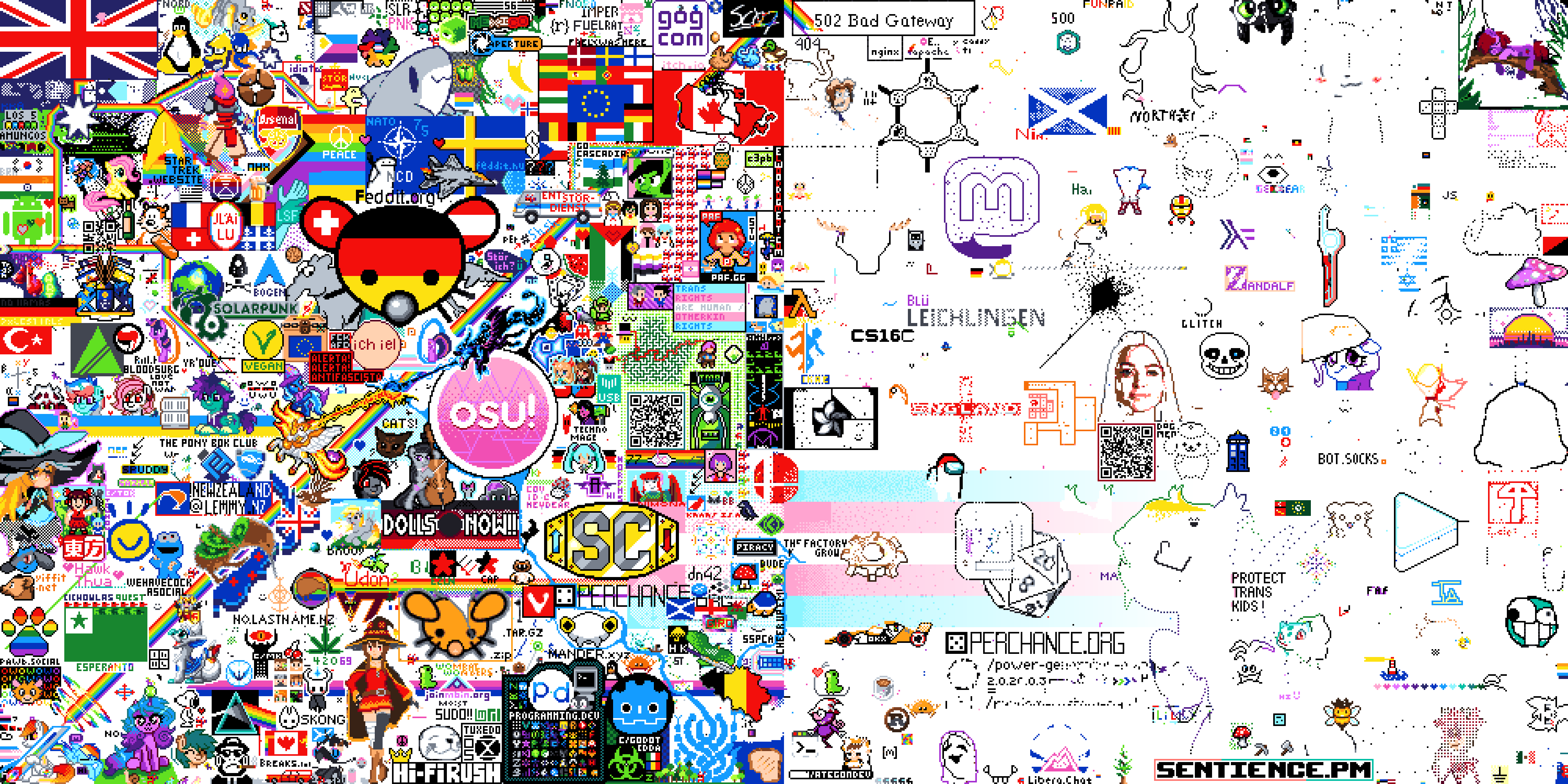
Edit: Not even Google Lens can scan it. (Edit edit: worked fine with screenshot.) Next time, avoid the red regions when putting logos etc. on mid-size (3+1 “squares”) QR codes:
🟥🟥🟥🟥
🟥🟩🟩🟩
🟥🟩🟩🟩
🟥🟩🟩🟥
You can rotate the code of course but not flip it.

If you’re using xkb, try this guide. Of course, backup any system files before modifying them, and just to be sure, add a 2nd keyboard layout as backup and know how to switch between them to have a fallback if you corrupt the primary one.
There might be TUI or GUI tools too, probably way more convenient for a one-off change on a single PC.

There used to be czech-lemmy.eu and kyberpunk.social instances, actually. Both ended less than a year ago.
Does not show up in my client, and the desc does not either when opening your profile.
?
Is this pair of tones used in the movie?
There is a song using just 2 tones a semitone apart in its melody, Šel nádražák na mlíčí (“When a train stationeer went foraging for dandelion greens”), allegedly written by Czech genius Jára Cimrman in the early 1900s.
Found a Czech. That makes about 7 of us. We should start a community!
Czechia… except we are landlocked. Poland, then?
I just changed one of the existing layouts. Very easy in any text editor, you just need to find the proper name or Unicode code for each function/character.

Be like me and just say BitTorrent.
Living in a country that doesn’t give a fuck:
+100% content
+50% healthcare
+90% safety from mass shootings
–40% salary
–60% job opportunities
–30% cost of living
That’s easy. The hard part is to justify why you needed to permanently flood LA to make a point.
uBlock Origin is so nice they discourage donations in favor of filter maintainers.

Time concerns aside, this will just make GOP say “they have their own idea of truth”. Which is correct but the causality is vice versa.
Fucking Aquaman??
Nope. But I guess a mirror of WebAssembly Studio would still be the best starting point despite its slow development lately. The WAsm plugin for VSCodium was broken for me too.
Note that unlike JS, WASM won’t run from file:// URLs; you need to run a local http server or commit to an online repo to run your code. There might be an about:config option to change this but many IDEs (incl. WA Studio, presumably) come with servers for this reason.







If it looks like this, it’s a lynx.