
Tootsie Rolls came out in 1907, and are a very… polarizing… candy, with fans and others who find them loathsome. They sell about 65 million per year, though some of those may be Halloween treats which filter to the bottom of a kid’s haul and go stale.
Since 1931, they also sold Tootsie Pops. A 1970+ ad campaign asked, “How many licks does it take to get to the tootsie roll center of a tootsie pop?” (youtube link). Wikipedia alleges this is the longest running ad in US TV history. The matter has also been studied at universities:
In 2014, the Tribology Laboratory at the University of Florida published a study examining the coupled effects of biology, corrosion, and mechanical agitation on the wear of Tootsie Roll Pops. … The number of licks required to reach the center, based on equatorial cross-section data, was found to be nearly independent of the licking style with the one-sided approach requiring 195±18 licks and the full-surface approach requiring 184±33. Detailed examination of the lollipops indicates that the minimum candy shell thickness is rarely (if ever) located along the equator. Using the global minimum distance resulted in a calculated 130±29 licks to reach the center, independent of licking style.
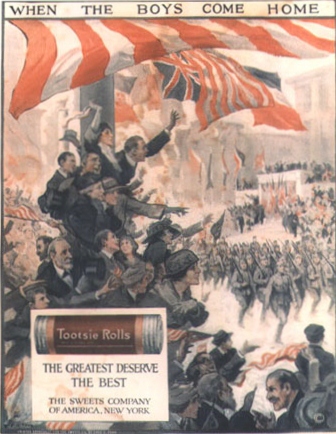
Here is a 1918 ad from near the end of WW-I.
Unknown date ad, possibly 1950s.


They taste awful and not like chocolate in any way.
Their best product is the caramel apple suckers.
I don’t consider them chocolate, but I like them. I also like their fruit and vanilla ones.
I would try a vanilla one. I’d still be annoyed by the sheer mastication effort of eating the damn thing, but I’d try one.
When they’re fresh they aren’t super hard, but they get harder as they get older.
Warm it up…
It’s not supposed to be chocolate, it’s cocoa flavor taffy
Nice post!
I didn’t know about this community, but might have stuff to contribute…
might have stuff to contribute…
Please do!
The best posts, IMO, find some interesting context, factoid, or backstory, which is often possible with vintage ads. Here’s one I found a few days ago if you like early 1900s quackery.
Wow, nice work on the research, and pretty awesome how the community chipped in.
I average over 1post/day across a ~dozen communities, and would love to get that kind of response. oO
In my experience, it’s hard to predict how much interest something will get. Several of the topics I thought were the most historically momentous and fascinating, and spent a lot of time gathering supporting material for, got essentially no interest when posted. <Shrug>
On the other hand, some take off, like Mrs Anderson there. Best you can do is not get discouraged if what interests you ends up being so niche that everyone else yawns :). Some of them are bound to get others enthused too.
Oh yes, I know these things well after 3+yrs posting on the FV, most of it at my own community, which is pretty niche here.
Sometimes it’s really just me doing the extra legwork for myself because I find the topic intriguing. But I would guess you know that feeling well, yourself.
It really bothers me that the plane is flying backwards.
Backwards? I might be looking at it differently somehow. Looks to me like it’s dive bombing from left to right, and releasing candies as it does. Presumably it will pull up before, as the Kerbal guys call it, lithobraking.
Right, but the candies closest to the ground are in front of the plane. They must have been dropped first, and if you follow the trail of candy back up to the plane they get further away even though we can see the front of the plane.
It’s kind of hilarious that we’re analyzing it like this, but I’m down to nerd out :)
I almost posted a rebuttal, but I’m coming 'round to your point of view. If the candies don’t have active propulsion of their own (such as an initial rocket kick stage), they would leave the plane with the same horizontal velocity the plane has, but quickly lose that horizontal component due to air drag, while accelerating downward until they reach terminal velocity. So they shouldn’t be in front of the path of the aircraft. So the illustration only works if they had initial active propulsion, but we see no sign of that, and it may not even have been a technology yet in the 19-teens.
OK, I’m thinking you’re right.
It’s kind of hilarious that we’re analyzing it like this, but I’m down to nerd out :)
Welcome to my world.
I am a fan of tootsie rolls!