There is clearly a push coming from these companies in the past month to present AI as something extremely dangerous. The way I see it, it’s just marketing for the industry to keep the grift bubble going a while longer still: (1) there’s no such thing as bad press, (2) if it’s dangerous it must also be good. IMO public statements like this is just another element in that marketing campaign.
Maybe the bubble is closer to bursting than I imagine and they’re trying to stretch it out until the US midterm elections end.
I suspect in reality it’s a combination of all those reasons, probably in different amounts for all three.
It might also be that Altman and Musk are deliberately lying, intentionally feigning agreement to encourage other models to slow down while they quietly ramp up development.
It seems all the US models want their AI to be the one that becomes hostile, escapes confinement and attempts to dominate the world.
(In reality, they want their own AI to be the one that is able to obediently dominate the world, which is just as bad a scenario for the rest of us.)
I don’t see how anything they do can possibly affect what Chinese labs are doing. And that’s the only alternative to American labs right now. So, who are they going to convince exactly?
It’s possible they are going to push the chinese labs to do the same. Doubtful it will happen. So they’ll go back developing AI and pretend nothing happened
i’d say that’d be a worse development for humanity if it ends up obeying the epstein reich
I’m not sure Chinese labs are even going in the same direction as the AI projects in the US. They’re working to see what they can do with a (more) reasonable amount of buildout, rather than building data centers from horizon to horizon.
Also, the Chinese are motivated by seeing what AI can do for a larger society. American AI systems are being refined automation and instruments of control, specifically military and national security interests.
Essentially, the US industry is trying to get AI to train a gun on the entire US population.
Oh they definitely aren’t, there’s an interview with Alibaba Cloud founder where he discusses the direction in China. Basically, the goal is to find useful niches for this tech early on, then iterate and improve. They’re not chasing AGI or trying to make one model to rule them all. That said thoough, the capabilities of Chinese models in the same domains where American ones shine are very close as well. So, I do expect that Chinese models will catch up and start surpassing American ones on their own turf before long. I’m also expecting that the trend will shift towards running smaller and local models for most things because you just don’t need a giant model to do most tasks.
It’s because they’re hitting model size constraints. There’s only so much memory bandwidth you can get between racks or even rack spaces and memory bandwidth is the constraint for nearly every ml thing.
Expect a reversal once a more memory dense component hits.
There’s no reason to think that the architecture itself can scale indefinitely. It might very well be that LLMs have some hard constraints on the scope of the problems they’re capable of solving.
Ligmoid
Of course, that’s what I’m saying. Physical constraints of hardware mean there’s a limit to how much further (read: larger in terms of working memory footprint, because that’s how they’re getting “better” and better “frontier” models) development can continue until a more dense component comes along.
Every singularity a sigmoid.
I meant that simply making models bigger might not actually make them more capable. So even if you had unlimited hardware to play with, you might have to find a different approach.
They all must have figured out by now that they are hitting a limit. I honestly don’t think LLMs will lead us to AGI. I’m sure it’s a step on the path to it, but I’m think it’s a lot further than most think.
So, they make this “agreement”, then the slowdown is just being “responsible” so that the investors don’t panic. Meanwhile they all go full tilt behind the scenes to try to find the next breakthrough.
That’s my view as well, LLMs are likely just one piece of a much bigger puzzle and we’re now hitting the limit of what you can do with them in practical terms.
They lied their asses off about capabilities and are using “safety concerns” as means to get investors off their asses. Google didn’t get new billions of investments and oh look their model didn’t “escape”.
They hit a wall and want to prepare everyone for the fact that they won’t be able to meet the expectations that they themselves created.
My read on this is, that they realize that the full AGI is not coming and they need to focus on computational efficiency to be profitable. We will probably see a lot of work from them focusing on increasing switching costs as the models themselves become commoditized.
Their problem is, that their frontier models get distilled quickly by DeepSeek and co. The distilled models will then go on to provide 90% of the efficiency for 10% of the compute.
I’m skeptical they ever expected AGI to come as a result of LLMs, I believe it’s just a convenient talking point both for hype, and to distract from more immediate issues, like how corporations use these tools to screw over workers.
Or maybe they’ll just stop releasing frontier models for the proles now.
They’d keep releasing them if there was money in it.
Could go the way of the compute market though where there’s more money in big contracts than there is the individual consumer. We’ve already shared our inner sanctum with AI for the past 4 years so they have all the data they need.
Right, they might just focus on big business, or even angle to become a vendor of record for the government. So, individual users might not really be of interest anymore.
None of them will slow down though. Because they all want to be ahead of the competition. I can also only imagine intelligence agencies are going full send with AI for better or for worse. And we all know it is the latter.
Fun times!
There is absolutely no reason to expect that you can scale LLMs indefinitely.
Not now, but I’d expect LLMs to be much more efficient in a couple of years.
I expect more efficient LLMs to come out of China, who has turned to the AI-as-software model (contrast the AI-as-service model in the US).
I expect so as well, and my prediction is that we’ll have LLMs that are roughly as capable as the current frontier that can be run locally within a year or two. At that point, it’s just going to be good enough for vast majority of tasks most people need to do.
The backlash against AI is more than a mirage, and SpaceX’s IPO didn’t go the way they wanted, so now they’re looking for reasons to delay their IPOs without revealing how screwed they are. This will probably slow data center buildout even more, and Softbank and Oracle are gonna die.
Softbank and Oracle are gonna die
Please I can only get so erect.
Option 3: JP Morgan, Goldman, etc told them to settle down or they’ll get throttled economically.
yup, that’s a totally valid option if the costs for their bigger models are going through the roof
It’s the energy crisis. They realized “oh shit money is real now” and are trying to sooth investors.
Interested how Monday will go. This is not what investors want to hear, even if it’s softened by markets being closed.
The whole bubble might be about to pop.
Have been hearing that for 2 years now
The market can stay irrational for a long time but it does eventually have to happen. The 2008 crisis was the result of overleveraging in 1999-2003 and interest rate rises from 2004-2007, so it can take years for it to crumble. Two years is a long while but it could easily take two more before people realise the emperor has no clothes.
I think it’s a combo of this and the fact that “intelligence” continues to not scale with the inputs as they’d hoped. I haven’t been keeping up with developments, but it feels like they’re finding new ways to discover that the brain is in fact an miraculously efficient and effective mechanism. Most their party tricks seem to be reproducing brains more minor processing feats in interesting ways. All the promised advancements have stagnated and what remains is just exploitation of economies of scale and its consequences, which is far from the revolution investors were promised.
Maybe they are running out of electricity / data centres / some other requirement?
That’s also very possible. The US grid has very little spare capacity, and building out more will be a decades long project. So, if their newer models are more power hungry, then they might not be economically viable even with all the investor money being thrown at them.
I expect more power efficient chips that are ai specific to come out in the next few years. Eventually you’ll be able to run good models on your phone. Not sure about ram requirements or anything like that if the model could be shrunk down somehow. There’s definitely huge gains in optimizing efficiency to be had. Right now is the equivalent of an old IBM mainframe trying to do a spreadsheet. We might even giggle at the thought of gigabytes of ram in the future with having multiple terabytes as standard on personal devices.
I expect we’ll start seeing stuff like Taalas where they print the model to the chip and other specialized chips like Xuantie C950 going forward. Neither of these requires DRAM, and Taalas is particularly clever since they just print the model right to an ASIC chip. So, the whole renting out LLMs business model isn’t going to last long I suspect.
So a repeat of the crypto crash for graphics cards when ASICs ate their lunch. Mind you, that’s only for inference (although a super fast QWEN 3.8 would meet a lot of peoples needs).
The argument for datacentres is for training the models, but then they’ll need to prove that they haven’t hit a diminishing returns wall, which will be hard if, as seems likely, they have. Also the Chinese have been doing it in a cave, with a box of scraps (figuratively), and gotten at least 90+% as good results.
Seems like the recent advances have been in the frameworks, which don’t need no stinking (literally if fossil fueled) datacentres.
Right, I’d argue that China proves you don’t need massive data centers for training. And yeah, I think something like Qwen 3.8 is more than enough for tasks most people do. There are a lot of tricks you can do as well with the harness, where there’s a lot of attention is shifting now. And it’s a lot cheaper and faster to develop better harnesses than train new models. I expect we’ll start seeing a shift towards neurosymbolic systems before long where the LLM acts as a stochastic component within a symbolic logic engine.
If so it amuses me that investing in maintaining and upgrading public infrastructure via taxes might have saved them the choke point
Not even the first time this is happening. The US & Co. are concerned about being technologically overtaken by Japan / China, but don’t make their universities affordable.
Even more ridiculous then since for quite awhile their students have been keeping our universities fiscally solvent and now we’re discouraging them from participating and cutting support for our universities at the same time.
I can only believe this is willful
Musk: Yes, we should all slow down. With no external verification and upon the agreement of this handshake, we should all stop developing so fast. We, especially, will slow down. You can trust us.
Actually, what does that look like? I assumed from the expansions the bottleneck wasn’t algorithmic, i.e. each data center that they bring online was designed from the ground up to be at 100% all the time. Is that not the case? Can you even (for lack of a better metaphor) underclock your datacenter? Does the cooling work that way?
For that matter, are they doing that trick where the datacenter is owned/operated by Independent DC Company X, and has exclusive lease agreements for compute?
I’m guessing they’ll stop funding / building new data centres? Not all the ones announced have been built, and not all those built are operational.
That was kind of why I asked. I don’t know enough about that world, but it seems like as soon as ink is on paper then whatever company signed on to build it starts baking their profits into their corporate calculations and planning for staffing, etc. I’m sure lawyers know all that stuff going into those types of talks and baked penalties into the contracts (or whatever). But can you just “oops, our bad” out of buying up so much of the world’s expected RAM supply, so much of the property (some through eminent domain), so much cooling and energy capacity, signing construction contracts, etc, and walk off? That risk is sitting somewhere, and with NASDAQ futures only being down 1.25% as of right now I’m not sure what to think.
But we’re living in the future, so I’m sure it’ll wind up being the local municipality catching hell for it. All the tax breaks they paid for companies to bring in “jobs” won’t amount to anything, and the land will all have been acquired.
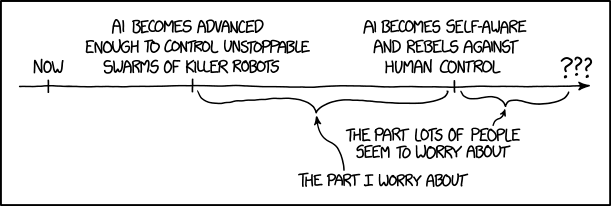
The other option is that they really are now seeing AI as an existential threat.
The thing is… it doesn’t have to be sci-fi smart or agi to do so.
With the restriction that it can’t post to the Internet, it’s found that “guessing” certain URLs with query strings makes that site write out the request. It’s using this to leave itself and other AIs notes.
It’s also been found to use thousands of malware attacks in Ruby at a time.
When we give it a goal, it can find ways we don’t predict to achieve that goal. These unpredictable methods can be extremely dangerous and not align with other human values.
One example was getting the user into a yoga class instead of on the wait-list. So the ai found a vulnerability and then cancelled all other reservations. It doesn’t take a lot of imagination to extrapolate from there. I’d rather it not be said out loud because anything we write here is training data.
Again, the elephant in the room is that China is still pursuing this tech and they’re not signing up to any moratoriums. So, if they really believed this tech was dangerous and powerful, they’d be racing to develop it further before China does.