German: “There are like…a lot of different ways to say ‘the’ based on case and gender and you’d better believe most answers you might come up with as a non-native speaker are wrong.”
English: “THE is THE!”
Seriously, English has its flaws, but the simplification of article adjectives is one area where it shines.
deleted by creator
it’s less that English simplified them and more that it never developed case marks for them.
Well, Old English baggs to differ. English lost its case markings on articles early on and kept them on nouns a while longer while German kept them on articles and simplified nouns much more early on.
In contrast, not only German repurposed the demonstrative “der” (that, which, who) into an article in a cleaner way
… as did English with “se”/“þē” which started as a demonstrative the same way der/die/das did.
but it’s also dumping most grammatical case info into the article
Again, German didn’t dump anything into articles but rather lost it everywhere else.
There is this idea that this fostered the process of using der/die/das much more often (which made it from a demonstrative to an article) but I disagree because it was a widespread process, not only in German but in huge parts of Europe, including beside Romance languages also English were this reasoning doesn’t work (as shown above).
deleted by creator
Finnish: “Wait, you guys have articles?”
The first thing that comes to mind when I hear “English has flaws” is the spelling. Consequence of being a mongrel language.
I also think it’s weird that we say the adjective before the noun, as opposed to, say, Spanish where it’s the other way around and you say what the thing is BEFORE describing it. “The white…” “The white what? THE WHITE WHAT??” “…wall.” “Oh, okay.”
Simplification is great for language learners but an outright flaw for lossy communication. Whenever you lose some part of a sentence through interference (like a movie that decided to have a scene with people whispering at actual whispering intensity) the redundancies help in understanding the correct meaning of the sentence.
Additionally, native speakers of any language (usually) have an intrinsic understanding of more complicated grammar so there is no real advantage in simplification for them.
deleted by creator
On the other hand having clearer forms allows for more complicated yet accurate sentences (not needed for communication but beautiful).
𝕯𝖎𝖊𝖘𝖊 𝕶𝖔𝖒𝖒𝖊𝖓𝖙𝖆𝖗𝖘𝖊𝖐𝖙𝖎𝖔𝖓 𝖎𝖘𝖙 𝖓𝖚𝖓 𝕰𝖎𝖌𝖊𝖓𝖙𝖚𝖒 𝖉𝖊𝖗 𝕭𝖚𝖓𝖉𝖊𝖘𝖗𝖊𝖕𝖚𝖇𝖑𝖎𝖐 𝕯𝖊𝖚𝖙𝖘𝖈𝖍𝖑𝖆𝖓𝖉
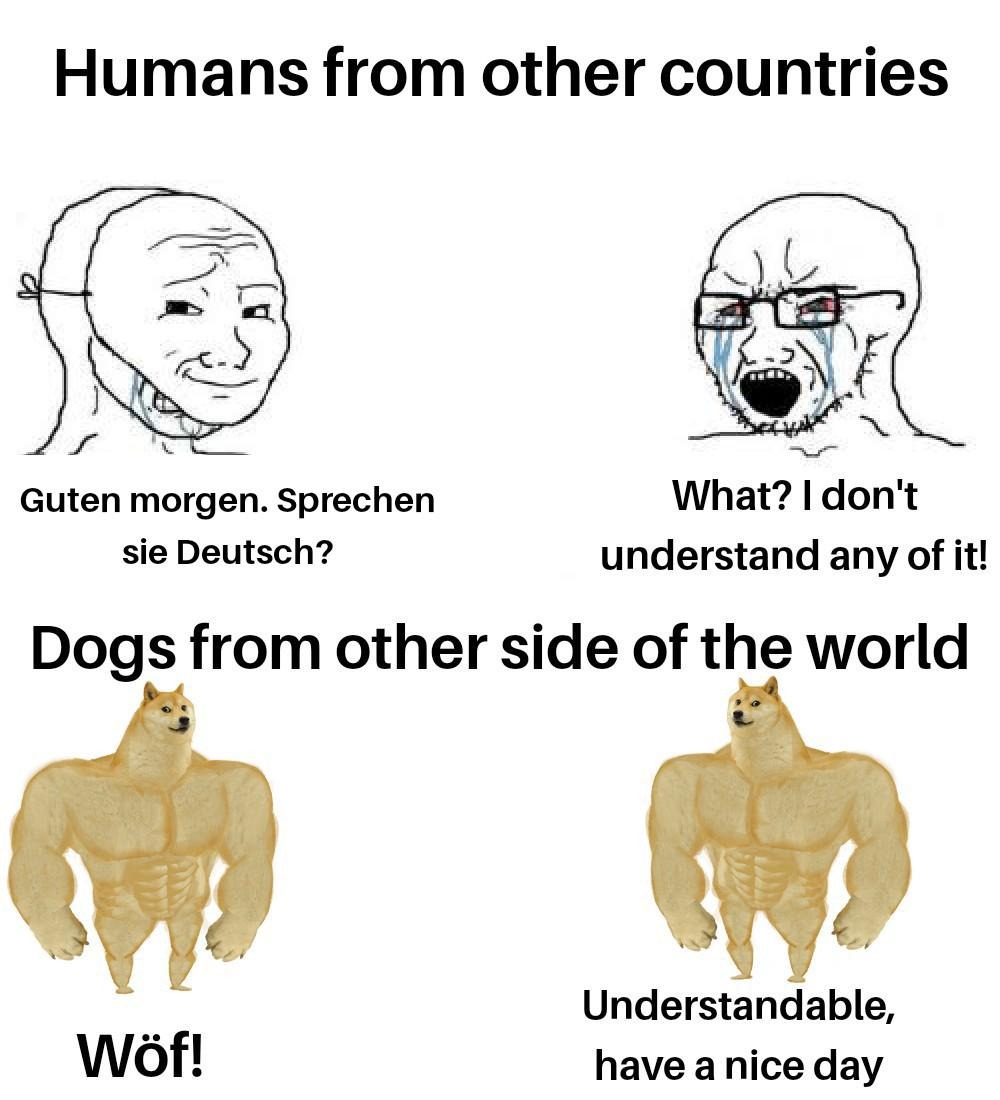
Me: screaming and weeping beside my father’s tire tread patterned body
Germans: Ich kann Sie nicht verstehen. Sprechen sie Deutsch?
Sorry but in France we say “Ouaf” signature look of supériorité
German dogs say “Wuff”. No idea what “Wöf” is.
French chicken: cot-cot-codet
It’s because of Babbel! God is punishing us for our pride and prejudice! /s
You got it all wrong! Babbel is an app to learn other languages, no punishment of any sort.
Just kidding, it’s an app to make monkey, not to help people.
make monkey
The cropping:

How is monke formed
I don’t know for dogs but I read that other species have different “accents” depending on their group and where they live.
Apparently, animals like dolphins, orcas and whales have different “accents”. And birds apparently also sign differently depending on their group and location.
Like, some ducks quack differently, from one region to another. I don’t think this can hamper simple communication, but there is apparently variation in their calls.
The smelling each other’s butt thing is also way more universal than all the different physical greetings humans have complicated life with.
Related to that, the whole physical signalling stuff is quite a mess.
For example there are cultures were waving your head up and down back and forth does not mean “Yes”, it means “No”.
I found this kind of stuff out when I moved from my homeland, Portugal, to The Netherlands: it turns out the signal for “he/she is crazy” in Portugal is the same as the signal for “he/she is intelligent” in The Netherlands. Mind you, for me it was a great source of humour.
“he/she is crazy” in Estonia would be making circles toward your temple with your index finger. What’s the gesture in Portugal?
Is that but on the side of the head. It can also be tapping on the side of the head.
The Dutch gesture for intelligent is touching the side of the head with the index finger, which can be confused with the second version of the Portuguese one for crazy.
Mind you, I just realized I’m not sure about those things anymore (I lived for over 2 decades abroad) and had to google to make sure.
The temple is on the side of the head I thought :) So you have the same gesture as we do I’d think.
Basically it’s usually aimed at the part of your head where your chewing muscles are.
Sprich Deutsch du Hurensohn
Wau wau? 🐕
Rüde.
*Sie. No wonder it doesn’t make sense.
*Morgen
.uoᴉʇɔǝɹᴉp ǝɯɐs ǝɥʇ uᴉ ʞlɐʇ llɐ ǝʍ ǝɯnssɐ oʇ noʎ ɟo ǝʌɐɹq
y
e
s
Wau, actually.
Dieser Kommentarbereich ist nun Eigentum det Bundesrepublik Deutschland
Humans can do body language too.